We Buy 90% Silver & Why Your Old Dime Was Worth $5
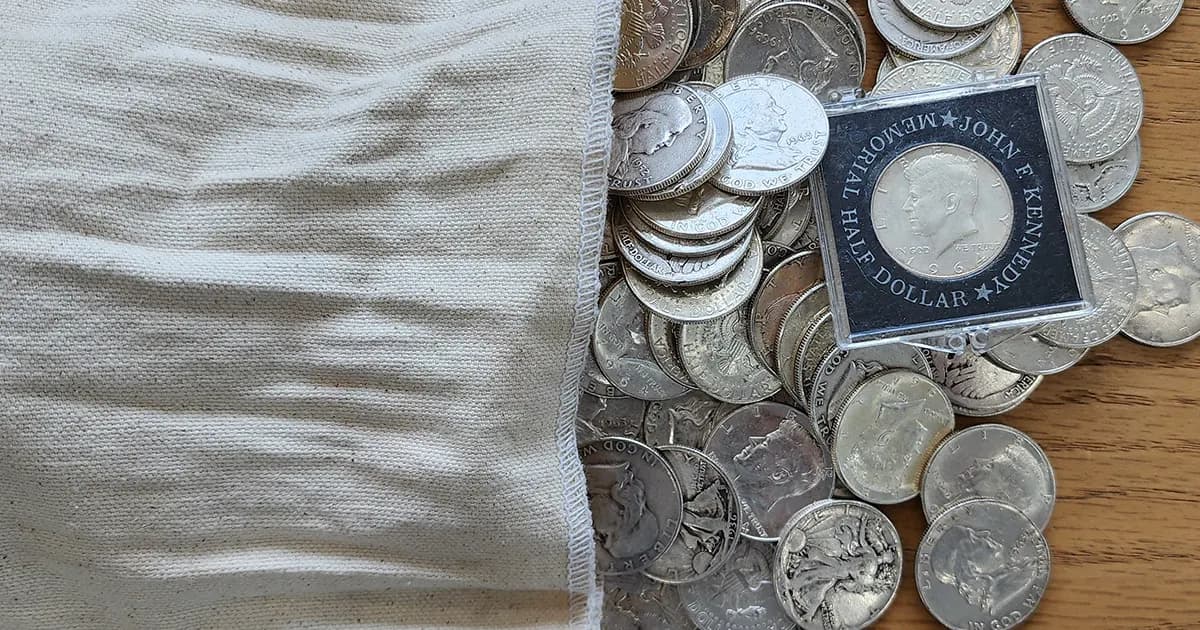
A lot of people ask if we buy 90% silver (generally pre-1964 dimes, quarters, half dollars and dollars – AKA Junk SIlver). The answer is yes which brings many people to our office.
When silver spot pushed past $100, we saw two very different reactions walk through the door.
Some people were stunned.
“How is this old dime worth four bucks?”
Others were confused.
“If silver is over $100, why isn’t my silver dollar worth $100?”
Both reactions make sense. And both come down to one thing: understanding what’s actually inside the coin.
Not All “Silver” Coins Are Pure Silver
One of the biggest misconceptions is that old U.S. coins are made from 100% silver.
They’re not. Many reasons including durability and cost to produce the coins.
Most common Morgan and Peace dollars, minted from 1878 to 1935, are 90% silver and 10% copper by weight. Because of that copper alloy, their actual silver content works out to about 0.7734 troy ounces of pure silver.
That means:
If silver is $100 per ounce
0.7734 oz × $100 = $77.34 in potential silver value
Not $100.
That’s why when spot silver was over $100, many Morgan and Peace dollars were trading around $50–$70 depending on market conditions and dealer spreads. The math simply didn’t support a $100 value unless the coin carried strong collector demand on top of its silver content.
And that leads to the next surprise.
A Dime Worth $5?
Before 1965, U.S. dimes, quarters, and half dollars were struck in 90% silver.
A pre-1964 dime contains about 0.0723 troy ounces of silver.
At $100 silver:
0.0723 oz × $100 = $7.23 in melt value
Even at $70 silver, that same dime holds about $5 in silver.
That’s where the shock came from.
People had jars of old change sitting in drawers. And suddenly, that “junk silver” wasn’t junk at all.
It was 40 times face value. Or more.
That moment tends to wake people up to two realities:
- Silver was once real money.
- Paper money quietly replaced it.
The Other Side of the Coin
While some were excited, others felt something different.
A little crushed.
Many families collected silver coins decades ago for their numismatic value. Dads and grandfathers carefully assembled sets of Morgan dollars, Peace dollars, Mercury dimes, Franklin halves. They bought them as collectibles. They imagined rarity, appreciation, history.
But as silver rose sharply, something unexpected happened.
For most common-date coins in circulated condition, the silver content began to exceed the collectible premium.
In other words, the metal became more valuable than the numismatic story.
When that happens, markets change behavior.
Coins that were once held for hobby value begin heading to refiners. They get melted, turned back into raw silver, and recast into bars, rounds, or industrial supply.
It can feel strange watching a coin collected for 40 years get valued purely for its melt weight.
But that’s how markets work. Intrinsic value eventually dominates when it gets large enough.
Why Some Silver Coins Aren’t Silver At All
Another surprise for many sellers is that not all “silver-looking” coins contain silver.
After 1964:
- Dimes and quarters became copper-nickel clad.
- Most half dollars after 1970 contain no silver.
- Modern circulating dollar coins contain no silver.
Unless it is:
- A special mint issue
- A commemorative
- Or an American Silver Eagle
…most modern U.S. coins are base metal.
That’s why we always verify before estimating a price. Assumptions can be costly in both directions.
Why 90% Silver Is So Popular
Despite the confusion, 90% silver coins are one of the most popular forms of physical silver in the U.S.
They are:
- Recognizable
- Fractional
- Highly liquid
- Easy to authenticate
- Backed by history
A bag of pre-1964 dimes and quarters contains known silver weight and carries strong demand during precious metal bull markets.
They’re often called “constitutional silver” because they were real circulating money.
And when silver moves sharply higher, they become highly sought after again.
Melt Value vs. Collectible Value
It’s important to understand there are two possible drivers of value in a coin:
- Metal content (melt value)
- Numismatic premium (collector value)
For rare dates in exceptional condition, numismatic value can dwarf melt value.
But for common-date circulated coins, melt value tends to dominate during strong silver markets.
That’s not a tragedy. It’s simply price discovery.
A coin bought for $20 decades ago may now be worth $60 or $70 because silver rose, even if it never became rare.
And that’s still a win.
40x Face Value Is Still Exciting
Even after the explanations and the math, most sellers leave excited.
Because here’s the simple truth:
A dime worth 10 cents on paper being worth $4 or more in metal is remarkable.
A dollar coin trading for $50 is not disappointing.
It’s a powerful reminder that tangible assets behave differently than currency.
When silver runs, 90% silver runs with it.
And whether those coins were saved in a cigar box, collected by a parent, or found in a forgotten drawer, they represent something rare today:
Money that still contains real money.
Why We Buy 90% Silver
We buy 90% silver because:
- It has clearly defined silver content.
- It trades actively.
- It carries strong demand.
- It remains one of the most trusted forms of physical silver in the U.S.
Sometimes it goes to collectors.
Sometimes it goes to investors.
Sometimes it goes to refiners.
But it always has value tied directly to the silver inside it.
And when spot silver moves, those old coins tell the story better than anything else.
Ready to Buy or Sell in Utah Valley?
Gold Silver Crypto is Highland, Utah's trusted precious metals dealer. Call or text for a same-day evaluation.