What the Silver Crash Actually Reveals About Precious Metals Markets
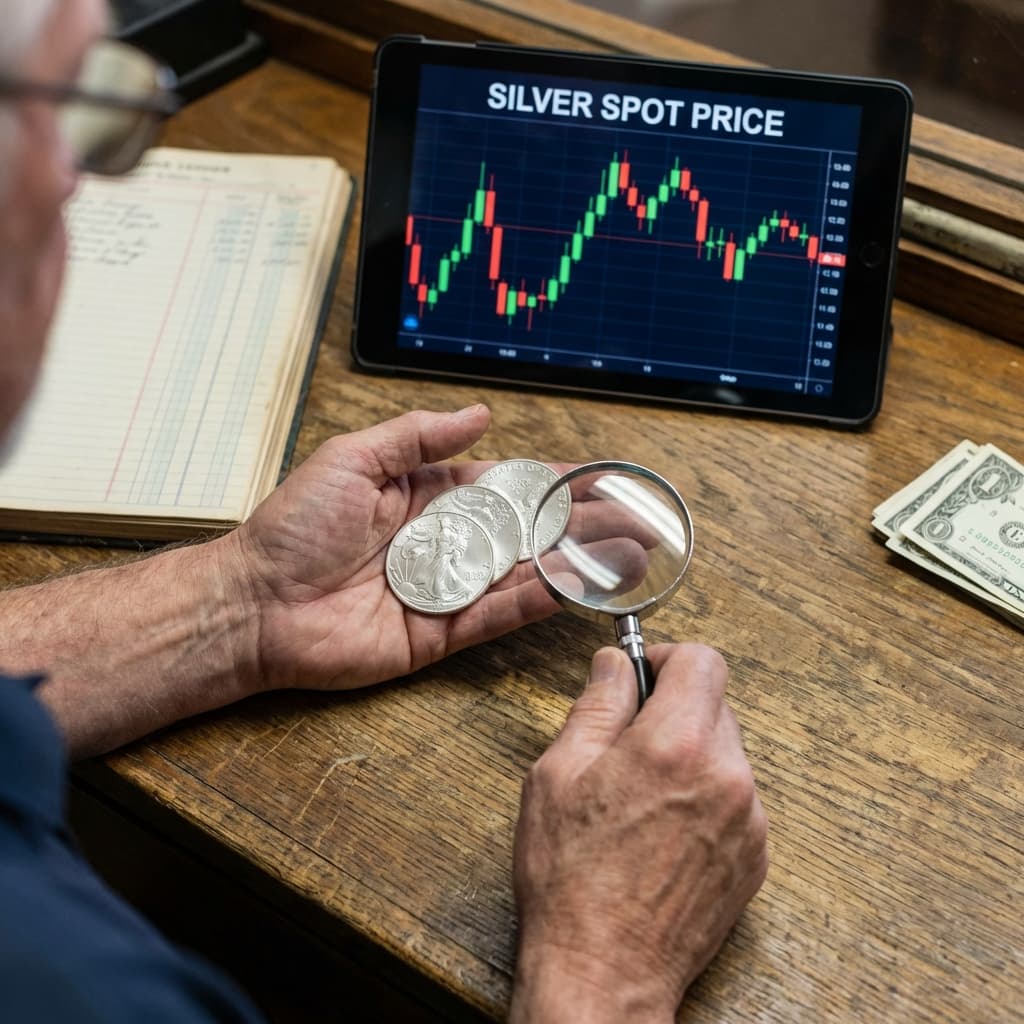
I watched silver climb to historic highs, then drop 33% seemingly overnight. And here’s what nobody’s talking about: people kept walking through my door.
Buyers and sellers, both showing up, both convinced they were making the right move.
That tells you something about precious metals markets that all the price charts and analyst predictions miss.
The Ground-Level View of Market Panic
I run a local precious metals and crypto exchange in Utah. Every day, I facilitate transactions between people and their gold, silver, and cash. I see the numbers, hear the stories, and watch the decisions play out in real time.
The recent volatility didn’t just move prices. It revealed fundamental truths about how these markets actually work versus how people think they work.
The parabolic rise felt inevitable when it was happening. Silver pushed toward all-time highs, and suddenly everyone had metals to sell or wanted to buy more before prices went higher. The forecasts got bolder—$150 silver this year, some said. Then came the retracement.
A 33% drop on January 30, 2026. Spot prices on a roller coaster. And the phone kept ringing.
Obviously those who missed the peak for selling were disappointed. Some were worried about a bigger correction and wanted out. A few thought it was still a good time to sell so they could buy back in a little cheaper.
On the buy side, many saw this as a great opportunity. They came in with expectations of silver heading to $150 and gold to $6,000 this year.
The Historical Context People Were Watching
What were sellers seeing that made them think it could drop even further?
People were looking back on 2011 or 1980 and all the news creating a stir. There were a lot of people still happy to take profits on silver they bought at $18 or $25 or even $50.
Having now lived through this 2026 correction, it wasn’t as scary as I or some other people imagined.
While most of the people who came in and sold before the correction were probably quite happy, we weren’t really selling much to buyers at the peak so we didn’t have a lot of unhappy people coming back.
A lot of the FUD in the marketplace surrounded paper traders. People trading long on margin took a hard hit getting liquidated. The CME increased margin requirements on gold from 6% to 8% and silver from 11% to 15%, forcing highly leveraged speculators to either pour massive amounts of capital into the system or close out their positions instantly.
That turned a market correction into a crash.
The Dollar Cost Averaging Reality
I had one buyer who bought a bit before the peak come back and buy the first dip before it dipped again. She was actually fine with it. She was about to buy more gold and silver the day before the correction and was quite happy to have missed that.
She did buy again after and uses DCA over the long run to come out ahead.
That’s the approach that makes sense in volatile markets. Not panic buying at the top or panic selling at the bottom, but steady accumulation based on belief in long-term value.
The Spot Price Myth Nobody Wants to Discuss
There’s a belief some people have that they can buy and sell at spot.
The reality is people usually buy over spot, especially for American Silver Eagles which probably carry the highest silver premium. Generally, people sell under spot. Dealers have a spread and make a little in the middle.
You know a person has experience when they lead with “what is your price over or under spot?”
We never want people to feel like they’re getting a bad deal. Sometimes the market is really soft. I’ve told many people they can shop around and encourage it if they are hesitant.
Yes, we have people shopping around but often found us either the only local shop buying in the frenzy or any day most often the best price. We’re told this all the time. Occasionally they will find a friend or neighbor and very infrequently another dealer that beats us.
What Changed With the Refiners
Buyers for silver became scarce at the top. Refiners don’t want junk silver. This has been the situation for months
The refiners are focused on .999 silver that they can turn into COMEX bars which are in demand in the commercial market. They are taking longer to pay or turn around .90 or .925 junk or sterling silver.
We’re pretty upfront about the problem with 90% right now. In most cases, people have called around and find we have the best offer or the only offer some days.
It was far worse when silver spiked in January and everyone was trying to dump it while they could.
Junk silver flooded the market in December and January with everyone trying to get out at a high price. Certainly some were expecting a correction. Others saw opportunity. We move with the market and when we couldn’t sell or wholesale it off, we had to lower our offer prices too.
The metals market isn’t very fixed so we have to be fluid with our offers. It can be tough.
The Room Full of Sellers
When we had to lower our offer prices because we couldn’t move the junk silver, how did customers react?
No one is happy with it, but people seemed to understand. When we had 3 or 4 sellers in the room at times, people got a feel for the market.
Most people don’t panic in front of us. Sure there are some people that have some urgency. But there certainly was a panic mentality up through the correction.
And mind you, that was the single biggest correction in silver in 46 years. In one day.
The crypto term FOMO was probably in play where people feared missing the high price. And then fear of what was next.
The Perspective Shift: From Fantasy to Devastating
I was too young to witness 1980. But I remember Black Monday October 19, 1987 mostly because my dad taught me about stocks and I was aware of that crash. I wasn’t heavily invested in metals in 2011. But I saw the time after that as opportune.
People are still uncertain today. Silver is down 10% again this very day. Some people are taking advantage. Others are worried about silver dropping further to $60 or even $50.
A year ago $50 was a fantasy. Today it seems devastating.
That shift in perspective reveals everything about how markets work. What feels like a collapse today might look like opportunity tomorrow. What felt like a missed opportunity yesterday might look like a bullet dodged today.
What I Tell People Who Are Worried
For the people coming in right now who are worried about it dropping to $60 or $50, what am I telling them?
Same thing I tell them at any price. We don’t have a crystal ball. It’s a smart long-term investment. If you’re buying for a quick buck, it’s a gamble.
That’s the honest answer. No hype. No promises. Just the reality of what precious metals are and how they function.
Despite the massive volatility, Citigroup still expects silver prices to reach a record $150 per ounce within three months. Bank of America’s Michael Widmer has projected silver could reach between $135 and $309 per ounce in 2026 based on historical gold-to-silver ratio compression.
Those predictions didn’t happen today. A day that is off significantly.
Maybe they’re right. Maybe they’re wrong. What I know for certain is that people will keep buying and selling regardless.
The 14-Year Holder Versus the One-Week Speculator
Last month, I had two transactions on the same day that perfectly illustrated the divide in this market.
One customer had held silver for 14 years. He walked in, showed me what he had, and we settled on a fair price based on current spot. He made a substantial return. He was patient, weathered multiple cycles, and chose his exit point deliberately.
Three hours later, someone who bought silver the previous week wanted to sell. The price had dropped. He took a loss.
Same metal, same market, completely different outcomes.
The difference wasn’t luck. It was approach, expectation, and understanding of what precious metals actually are.
The 14-year holder treated silver as money, a store of value that would appreciate over time but required patience. The one-week holder treated it as a speculative trade, expecting quick gains.
Both approaches exist in this market, but only one aligns with how precious metals actually function. You can’t day-trade physical silver like you can stocks or crypto. The transaction costs, the spread between buy and sell prices, and the physical nature of the asset make short-term speculation difficult at best unless you’re in stocks or ETFs that are metals based.
The Liquidity Problem Nobody Addresses
This brings me to the problem nobody in the precious metals industry wants to address directly: liquidity. Or more accurately, the lack of it.
You can buy gold and silver easily enough. Holding it creates three immediate challenges—storage, insurance, and security. You need a safe place, you need to protect it, and you need to keep it secure.
These aren’t small considerations when you’re holding significant value in physical form.
But the real problem emerges when you want to sell. Right now, the market is soft.
When people come to me expecting spot price for their metals, I have to explain reality. You’re not going to get spot for precious metals now, and maybe not ever. There’s always a spread. Always transaction costs. Always the reality that someone has to want to buy what you’re selling at the price you want.
I’ve had numerous people tell me my offer is too cheap. I get it—nobody wants to hear that their investment is worth less than they hoped. Often, they leave to shop around. And almost as often, they come back.
Because the market reality doesn’t change based on what we wish it would be.
Why I Built This Business
I wanted to make metals more liquid, more accessible, more usable. If gold and silver are money—and I believe they are—then you should be able to convert them to cash or other forms of value without jumping through hoops or getting taken advantage of.
The three main drawbacks of precious metals are storage, insurance, and liquidity. I can’t solve the first two for people, but I can address the third by being a reliable, transparent local option for buying and selling.
I recently facilitated a transaction where someone paid for gold with part Bitcoin and part cash. I’ve sold gold for USDT and USDC. I’ve done exchanges between metals and various cryptocurrencies.
These are all exchanges of value, real money in my view.
The flexibility to move between gold, silver, cash, and crypto addresses the liquidity problem in a way that traditional precious metals dealers can’t or won’t. It makes metals more accessible, more usable, more integrated into how people actually manage their money.
The Gap Between Forecasts and Transaction Reality
The recent volatility exposed something else: the gap between speculative forecasts and transaction reality.
When silver was climbing, the predictions got aggressive. $150 this year. Higher next year. Maybe they’re right—I don’t have a crystal ball. But I do have transaction data.
I see what people actually pay and what they actually receive when buying and selling. That ground-level view reveals a market that’s more complex and less predictable than the forecasts suggest.
External factors matter enormously. Economic policy, inflation rates, dollar strength, geopolitical uncertainty—all of it feeds into precious metals pricing. But the overnight 33% drop wasn’t just about fundamentals.
It was about sentiment shifting, leveraged positions unwinding, and the reality that precious metals markets can move fast in both directions.
The spot price roller coaster isn’t an anomaly. It’s a feature of markets that exist at the intersection of commodity trading and monetary philosophy.
What Continued Market Participation Reveals
What’s interesting is that continued market participation despite massive volatility suggests something deeper than pure speculation.
People keep buying. People keep selling. Both sides believe they’re making the right move. And it may be a move some have to make. Bills and life.
The buyers see long-term value, inflation protection, and a hedge against economic uncertainty. The sellers see profit-taking opportunities, rebalancing needs, or simply the desire to convert an illiquid asset into cash they can use.
I’ve been building businesses for almost 30 years. I’ve seen ups and downs across retail and manufacturing. The precious metals market isn’t fundamentally different from other markets in one key respect: price reflects the intersection of supply, demand, and belief.
But it is different in another crucial way: precious metals carry philosophical weight that most commodities don’t.
Whether gold and silver are “real money” isn’t just an academic question. It shapes how people approach these markets and what they expect from their investments.
My Polarizing View on Metals as Money
I believe gold and silver are money, regardless of what others say.
Currency has limitations. While it’s liquid, it doesn’t appreciate. In fact, it depreciates in buying power over time. People outside of the business or belief in precious metals can’t seem to grasp that.
They’re the same people getting 0.5% interest in their savings account, 4% in a bond, and 6% in mutual funds while gold and silver have risen substantially over the past two years.
That’s a polarizing view, I know. Some will agree passionately. Others will dismiss it entirely.
But here’s what I can say without speculation: the transaction patterns I see suggest that belief in precious metals as a store of value remains strong despite volatility.
The 33% retracement didn’t kill the market. It didn’t stop people from participating. It separated the speculators from the believers, the short-term traders from the long-term holders.
And it revealed who actually understands what they’re buying versus who’s chasing price movements.
Why Local Transparent Dealers Matter More Now
The role of local, transparent dealers matters more in volatile markets than most people realize.
When prices are swinging wildly, when forecasts conflict, when you’re trying to make a significant financial decision, having someone you can look in the eye and ask questions makes a difference.
I’m not running a high-pressure boiler room operation trying to make huge commissions. I show people spot pricing and buy or sell according to that. The numbers speak for themselves.
Some people really don’t know what they have or what it’s worth. That information asymmetry creates opportunities for predatory operators to take advantage.
I’ve seen it throughout my career in this industry. I ran a mint in Ohio, saw how the industry works behind the scenes—the good, the bad, and the opportunities.
That experience taught me there’s a better way to do this. A way that prioritizes transparency, fair dealing, and education over maximum profit extraction.
What the Market Environment Demands Right Now
The current market environment—post-crash, still volatile, with conflicting forecasts—is exactly when people need straight talk the most.
Yes, long-term holding strategies in precious metals have historically yielded substantial rewards. Yes, patience matters.
But timing also matters. Market cycles matter. Understanding what you’re buying and why you’re buying it matters. And knowing when to sell, when to hold, and when to walk away from a bad deal matters enormously.
What the silver crash revealed isn’t that precious metals are a bad investment or that the forecasts were wrong.
It revealed that these markets are complex, that volatility is inherent, and that your approach matters more than your timing.
The person who held for 14 years won. The person who bought last week and sold in a panic lost. Same market, different outcomes, based entirely on strategy and understanding.
The Fundamental Question That Determines Everything
The forecast of silver reaching $150 this year reflects speculative optimism. Maybe it happens, maybe it doesn’t. That would be a 100% jump from today’s low. But no one was expecting $120 a year ago and it happened.
What I know for certain is that people will keep buying and selling regardless. The market will keep moving. And the gap between what people expect and what actually happens will continue to create both opportunities and disappointments.
My goal isn’t to predict where prices go next. It’s to provide a place where people can transact fairly, quickly, and transparently regardless of market conditions.
Whether you’re the 14-year holder finally cashing out or someone buying their first silver coins, you should get a fair deal, clear information, and the confidence that you’re working with someone who treats these transactions seriously.
The precious metals market will remain volatile. External factors will continue to drive price swings. Forecasts will continue to range from conservative to wildly optimistic.
And people will keep showing up, convinced they’re making the right move.
What matters is understanding what you’re really buying, why you’re buying it, and what role precious metals actually play in your financial strategy.
Everything else is just noise around the fundamental question: do you believe gold and silver are money, or don’t you?
Your answer to that question determines everything else.
Disclaimer: This article represents personal observations and experiences from facilitating precious metals transactions. It is not financial advice. Always do your own research and consult with qualified professionals before making investment decisions.
Ready to Buy or Sell in Utah Valley?
Gold Silver Crypto is Highland, Utah's trusted precious metals dealer. Call or text for a same-day evaluation.