$10 Liberty Gold Eagle
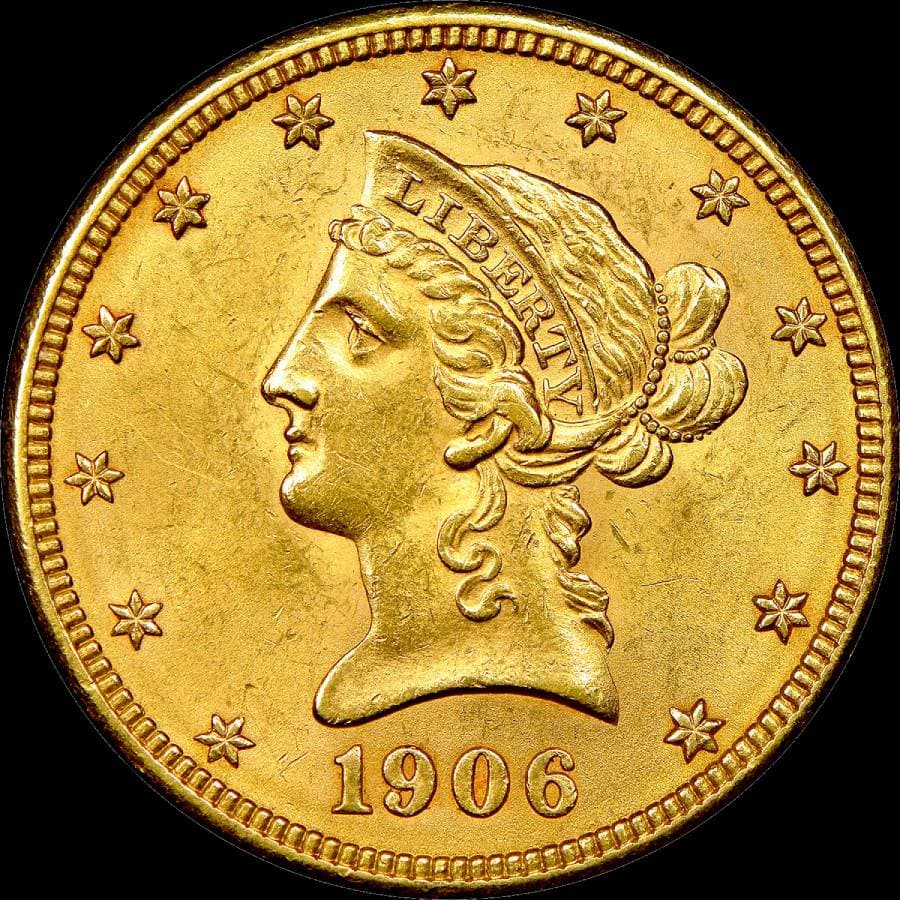
Images are for educational/reference use and may not represent current inventory.
Gold Silver Crypto sells $10 Liberty Gold Eagles, with live spot-based pricing and secure checkout. Pricing depends on live gold value, date, mintmark, design type, condition, authenticity, certification, and current numismatic demand.
Related Products
$10 Liberty Gold Eagle Specifications
| Metal | Gold |
| Purity | 90% gold / .900 fine |
| Actual gold content | Approximately 0.48375 troy oz |
| Total weight | Approximately 16.718 g |
| Diameter | Approximately 26.8–27 mm |
| Face value | $10 legal tender |
| Designer | Christian Gobrecht |
| Issue years | 1838–1907 |
| Major types | Covered Ear, No Motto, and With Motto |
| Mints | Philadelphia, New Orleans, San Francisco, Carson City, and Denver |
| Edge | Reeded |
“Eagle” is the historical name of the U.S. $10 gold denomination — it is not a statement about weight. The coin does not contain one full troy ounce, and it does not contain exactly one-half troy ounce either. It contains approximately 0.48375 troy ounce of pure gold. Total weight is higher than actual gold content because the coin is a 90% gold alloy, not pure gold, and the $10 face value is not the coin's modern market value. Date, mintmark, type, condition, authenticity, grade, and certification may all add numismatic value on top of the coin's gold content. Numismatic references may identify this series as the Liberty Head $10 Eagle or Coronet Eagle, but the product name on this website remains $10 Liberty Gold Eagle.
About the $10 Liberty Gold Eagle
The U.S. Mint had not struck $10 gold coins since 1804. Christian Gobrecht's Liberty Head design resumed the Eagle denomination in 1838, and before the $20 Double Eagle was introduced in 1850, the $10 Eagle was the largest circulating gold coin the United States produced. The earliest coins, dated 1838 and part of 1839, use a portrait now commonly called the Covered Ear or Type of 1838. Later in 1839, Gobrecht reworked Liberty's portrait, and that revised design remained standard for the rest of the series.
Production occurred at Philadelphia and, at various points, at New Orleans, San Francisco, Carson City, and Denver. IN GOD WE TRUST was added to the reverse in 1866, dividing the series into No Motto and With Motto types. Regular production continued through 1907, when the design was replaced by the Indian Head Eagle.
The coin circulated in commerce, banking, and reserves throughout the 19th century, and many surviving examples show wear, bag marks, or handling from decades of use. Date, mint, surviving population, and condition matter more for value than age alone — some later dates are common today, while others, particularly certain branch-mint issues, are genuinely scarce.
How to Identify a $10 Liberty Gold Eagle
Obverse
Liberty faces left, hair pulled back, wearing a coronet inscribed LIBERTY. Thirteen stars surround the portrait, with the date below. The early Covered Ear portrait, used in 1838 and on part of the 1839 mintage, differs from the revised portrait introduced later in 1839 and used for the remainder of the series.
Reverse
An eagle with a shield holds an olive branch and arrows, surrounded by UNITED STATES OF AMERICA and the denomination TEN D. With Motto coins carry a ribbon reading IN GOD WE TRUST above the eagle. The branch-mint letter, where present, appears on the reverse below the eagle, though exact placement can vary slightly by mint, date, and die.
The coin measures approximately 26.8–27mm in diameter, weighs approximately 16.718 grams, and has a reeded edge. Correct weight alone does not prove authenticity, and correct gold purity alone does not prove U.S. Mint origin — counterfeit gold coins and altered mintmarks exist in this series. Because of this, visual inspection and professional testing or certification are important before relying on a coin's stated details for pricing.
The Three Major $10 Liberty Gold Eagle Types
The series is divided into three major design groups. Design, not date alone, determines a coin's type.
Covered Ear $10 Liberty Gold Eagle
The Covered Ear design, also called the Type of 1838, was introduced in 1838 and continued on part of the 1839 mintage. Liberty's portrait on this early type differs from the later design — the ear is largely covered by the hair arrangement, and the bust and lettering are noticeably different from what followed. Major numismatic references classify it as a distinct design type, not simply an early version of the later portrait. Early examples are not automatically equal in rarity or condition to one another, and because more than one portrait type exists within 1839, any 1839-dated coin requires design inspection rather than an assumption based on the date alone.
No Motto $10 Liberty Gold Eagle
Gobrecht reworked Liberty's portrait during 1839, and this revised design, without an IN GOD WE TRUST ribbon on the reverse, continued through the 1866 transition. Production during this period came from Philadelphia, New Orleans, and San Francisco. Date and mintmark matter significantly within the No Motto period — some issues are common, while others are genuinely scarce. The 1866-S No Motto issue is a distinct, separately recognized coin and must not be confused with the 1866-S With Motto issue struck the same year.
With Motto $10 Liberty Gold Eagle
IN GOD WE TRUST was added to a ribbon above the eagle starting in 1866, and this With Motto design continued through 1907. Production during this period came from Philadelphia, San Francisco, Carson City, New Orleans, and, at the very end of the series, Denver. Carson City production began in the 1870s and carries strong collector recognition. Denver production occurred only in 1906 and 1907, the final two years of the series. A later date does not automatically mean a coin is common — grade, mintmark, and specific date all still matter, and 1866 remains a transition year requiring design inspection rather than a date-based assumption.
The 1838 and 1839 Design Transition
1838 was the first year of the $10 Liberty Gold Eagle, and the original portrait used that year is commonly identified as the Covered Ear, or Type of 1838, design. Coins dated 1839 exist with two different portrait styles: part of the 1839 mintage continued the Type of 1838 portrait, while Gobrecht reworked the bust later in the year, and this revised portrait became the standard design for the rest of the series.
Date alone is not enough to identify the correct 1839 type — the portrait itself must be examined, since both varieties share the same 1839 date. Early pieces, particularly 1838 and 1839 coins, deserve careful authentication and attribution rather than an assumed rarity premium based only on the date.
No Motto vs. With Motto
No Motto $10 Liberty Gold Eagles lack the ribbon carrying IN GOD WE TRUST on the reverse. With Motto coins include that ribbon above the eagle. The transition occurred in 1866, when the motto was added to the reverse design.
Both No Motto and With Motto 1866-S issues exist as separately recognized coins, since San Francisco struck examples of each type that year. Not every 1866 coin should be assigned the same type — the reverse design, not the date alone, determines whether a specific coin is No Motto or With Motto. Type, mintmark, grade, and condition can all affect value independently of one another.
$10 Liberty Gold Eagle Mintmarks
The $10 Liberty Gold Eagle was struck at five different mint facilities. The mintmark generally appears on the reverse, below the eagle, though exact placement can vary slightly by mint, date, and die.
The $10 Liberty Gold Eagle was not struck at Charlotte or Dahlonega.
Unlike several smaller Liberty gold denominations, this series has no Charlotte ‘C’ issues and no Dahlonega ‘D’ issues.
Philadelphia
No mintmark. Produced coins throughout the series. A no-mintmark coin is not automatically common — some early Philadelphia dates are among the scarcest issues in the series.
New Orleans
‘O’ mintmark. Produced selected No Motto and With Motto issues. Some New Orleans dates are much scarcer than others, so no single universal New Orleans premium applies.
San Francisco
‘S’ mintmark. Produced issues beginning during the Gold Rush era, including both No Motto and With Motto coins. Mintmark placement may vary slightly by die and date. Some San Francisco issues are major rarities, while others are more available.
Carson City
‘CC’ mintmark. Appears in the With Motto portion of the series and carries strong collector recognition. Not every Carson City issue has the same rarity or value, and authentication remains important given the series' popularity with counterfeiters.
Denver
‘D’ mintmark. Applies only to the final-period Denver issues, 1906-D and 1907-D, struck as the Liberty Head series was ending. A genuine ‘D’ on this series means Denver, not Dahlonega — Dahlonega never struck this denomination.
Common Dates, Better Dates, and Rare Issues
Not every $10 Liberty Gold Eagle should be priced the same way. Many later Philadelphia and San Francisco issues are encountered more frequently and trade mainly on gold content plus a market premium. Carson City issues vary significantly by date, and both New Orleans and San Francisco contain a mix of relatively available dates and major rarities. A mintmark alone does not establish final value — original mintage is only one factor, and surviving population, grade, surface condition, certification, and current demand matter just as much.
A number of dates are established rarities within the series, including the 1838 and early 1839 issues, 1864-S, the 1866-S No Motto issue, the 1875 Philadelphia issue, and 1883-O. This is not a complete key-date checklist, and specific dates should be verified through PCGS or NGC before a numismatic premium is assigned. High-grade examples of otherwise available dates can also be valuable, and proof coins occupy a separate, much scarcer market from business-strike coins. Added and altered mintmarks exist within this series, so any rare-date or rare-mintmark claim requires authentication before it is relied on.
Raw vs. Graded $10 Liberty Gold Eagles
PCGS and NGC are third-party grading services that authenticate a coin and assign a numeric grade reflecting its condition. A certified holder provides an independent opinion on authenticity and grade, but a holder does not automatically make a coin rare — date, mintmark, type, and grade can all materially affect a coin's collector value beyond what certification alone indicates.
Certification numbers should be verified against the grading service's public records, and cracked, damaged, or tampered holders require careful inspection before relying on the labeled grade. Raw, uncertified coins can still be purchased after authentication — that authentication is completed during the in-person evaluation before a transaction is finalized. Gold Silver Crypto evaluates the actual coin and current market conditions, not merely the holder label it arrives in. We do not recommend removing a coin from its holder.
$10 Liberty Gold Eagle vs. Modern $10 American Gold Eagle
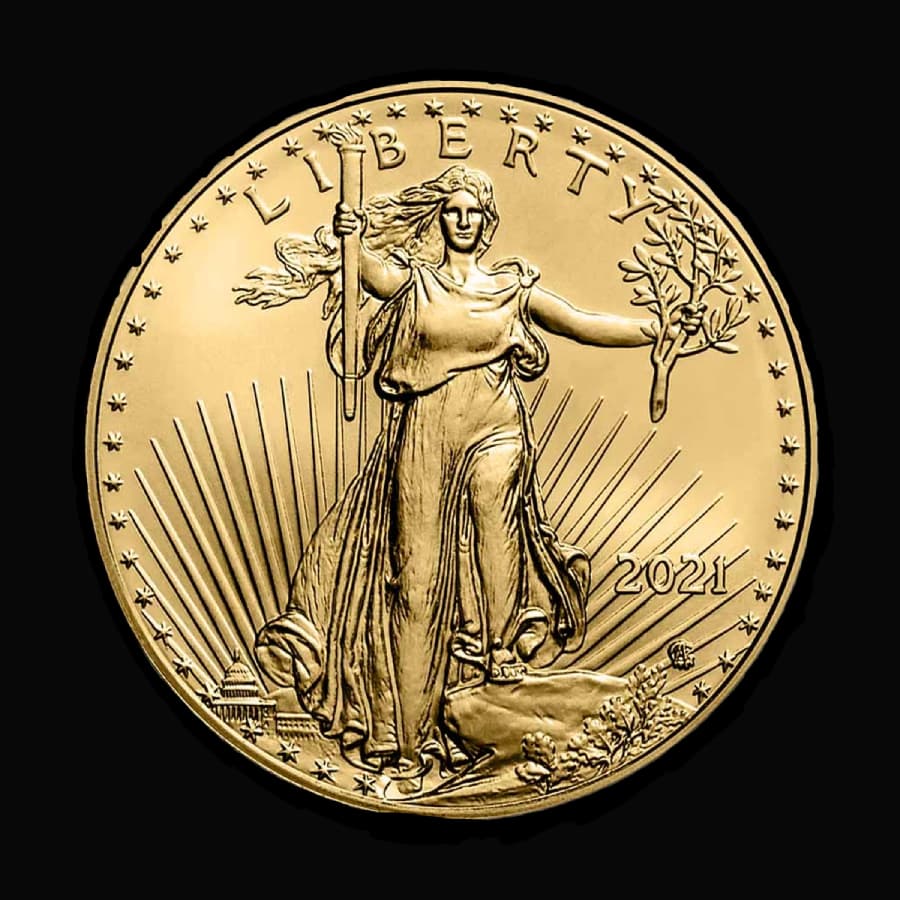
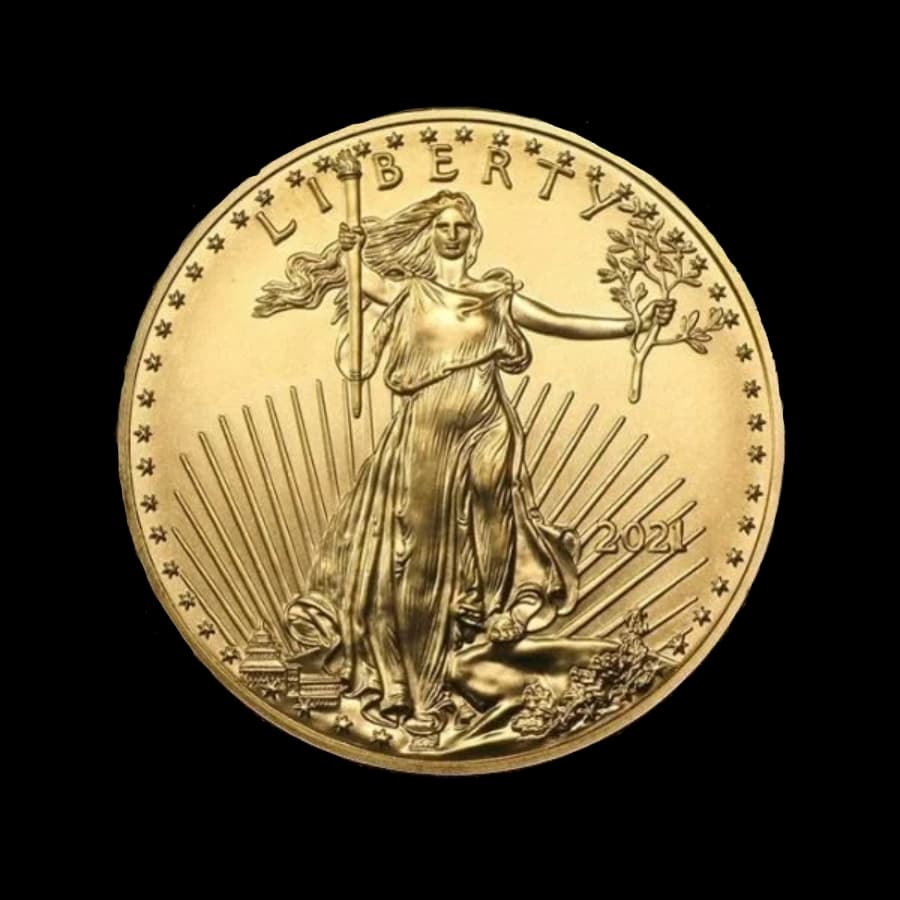
Both coins carry a $10 face value, but that shared denomination does not mean they contain the same amount of gold. The American Gold Eagle 1/4 oz size is a modern bullion coin.
| Feature | $10 Liberty Gold Eagle | Modern $10 American Gold Eagle |
|---|---|---|
| Coin type | Historical pre-1933 gold coin | Modern bullion coin |
| Issue years | 1838–1907 | 1986–present |
| Face value | $10 | $10 |
| Purity | .900 fine | .9167 fine |
| Actual gold content | Approx. 0.48375 oz | 0.250 oz |
| Total weight | Approx. 16.718 g | Approx. 8.483 g |
| Diameter | Approx. 26.8–27 mm | Approx. 22 mm |
| Main value factors | Gold content plus possible numismatic value | Gold content plus bullion premium |
The historical $10 Liberty Gold Eagle contains almost twice the gold of a modern quarter-ounce Gold Eagle. “Eagle” does not indicate one ounce, and face value is not the modern market value for either coin. The two products should not be priced interchangeably.
$10 Liberty Gold Eagle vs. Liberty Head $20 Double Eagle
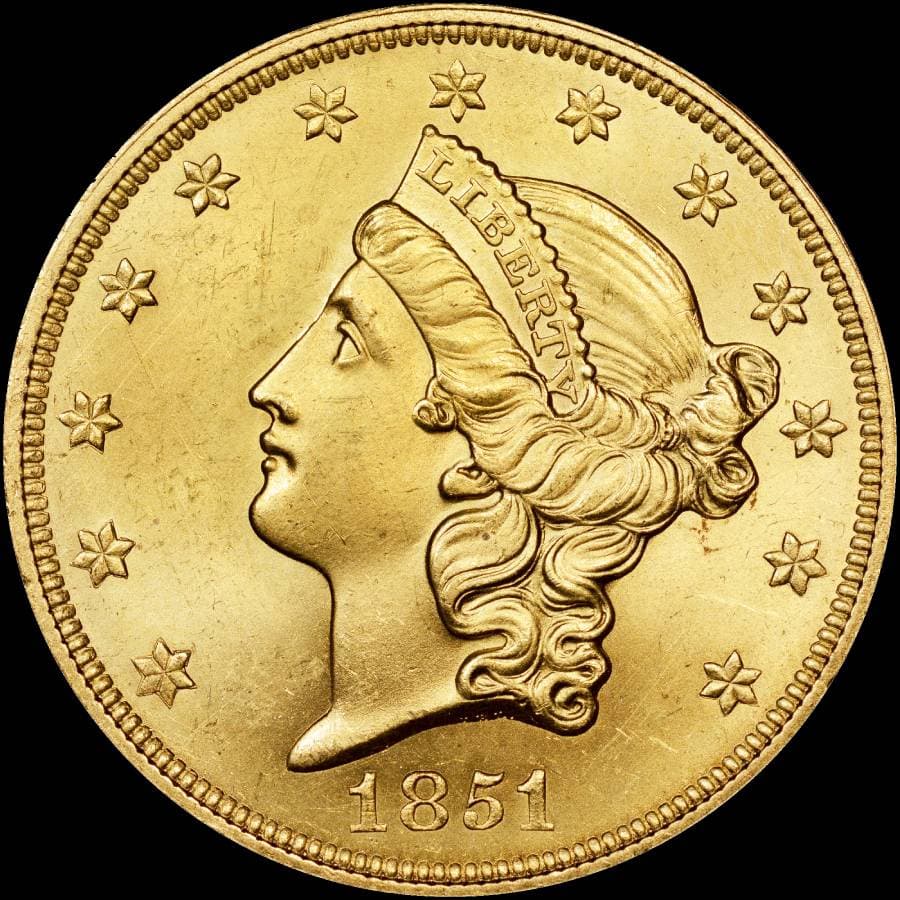
Both use Liberty Head or Coronet imagery from the same general era, but the Liberty Head $20 Double Eagle contains roughly twice the gold.
| Feature | $10 Liberty Gold Eagle | Liberty Head $20 Double Eagle |
|---|---|---|
| Face value | $10 | $20 |
| Actual gold content | Approximately 0.48375 oz | Approximately 0.9675 oz |
| Total weight | Approximately 16.718 g | Approximately 33.436 g |
| Diameter | Approximately 26.8–27 mm | Approximately 34 mm |
| Issue period | 1838–1907 | 1850–1907 (regular circulation) |
| Designer | Christian Gobrecht | James B. Longacre |
| Major types | Covered Ear, No Motto, With Motto | Type 1, Type 2, Type 3 |
| Mints | Philadelphia, New Orleans, San Francisco, Carson City, Denver | Philadelphia, New Orleans, San Francisco, Carson City, Denver |
| Primary value factors | Gold content plus possible numismatic value | Gold content plus possible numismatic value |
The $20 Double Eagle contains approximately twice as much gold as the $10 Liberty Gold Eagle, but numismatic premiums vary independently between the two series, so a simple two-to-one market-value assumption does not hold. They are different denominations and different product pages.
$10 Liberty Gold Eagle vs. Liberty Head $5 Half Eagle
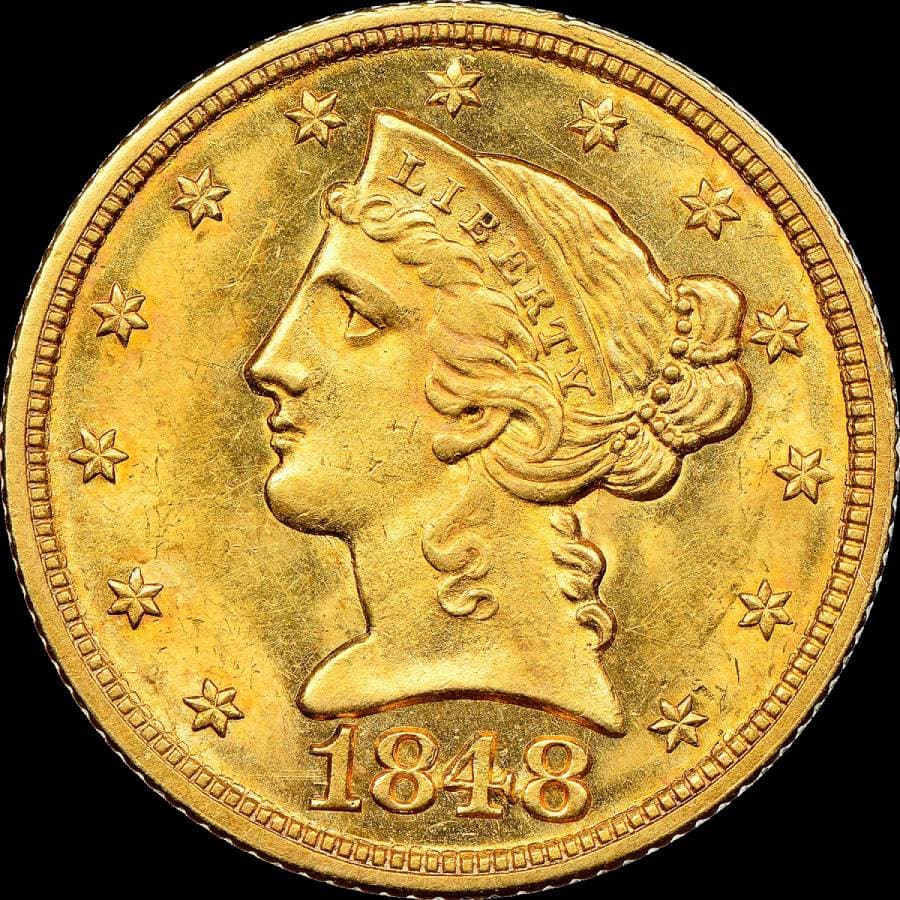
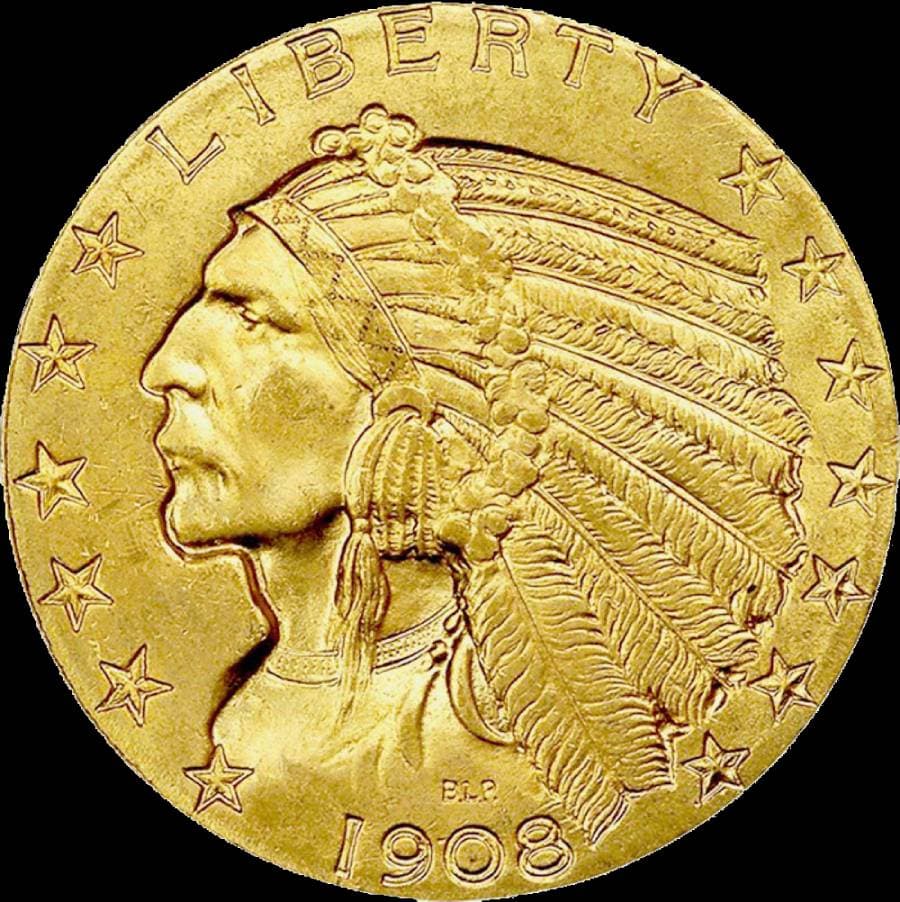
Both were designed by Christian Gobrecht and share a No Motto/With Motto design history, but the Liberty Head $5 Half Eagle is a smaller coin with a different mint history.
| Feature | $10 Liberty Gold Eagle | Liberty Head $5 Half Eagle |
|---|---|---|
| Denomination | $10 Eagle | $5 Half Eagle |
| Actual gold content | Approximately 0.48375 oz | Approximately 0.24187 oz |
| Total weight | Approximately 16.718 g | Approximately 8.359 g |
| Diameter | Approximately 26.8–27 mm | Approximately 21.6 mm |
| Issue period | 1838–1907 | 1839–1908 |
| Designer | Christian Gobrecht | Christian Gobrecht |
| Major types | Covered Ear, No Motto, With Motto | No Motto, With Motto |
| Mints | Philadelphia, New Orleans, San Francisco, Carson City, Denver | Philadelphia, Charlotte, Dahlonega, New Orleans, San Francisco, Carson City, Denver |
| Charlotte / Dahlonega issues | None — this denomination was not struck there | Both mints struck this denomination |
The $10 Eagle contains approximately twice the gold of the $5 Half Eagle, but numismatic premiums vary independently of gold content between the two series. Do not assume the mint list for one denomination applies to the other — the Half Eagle series includes Charlotte and Dahlonega issues that the Eagle series does not.
Our Take
Common-date $10 Liberty Gold Eagles combine nearly half an ounce of gold with genuine historical interest. Their size can be attractive to customers who want a substantial pre-1933 coin without buying a full Double Eagle.
They are not automatically the cheapest way to buy gold. A buyer focused only on accumulating ounces may find modern bullion coins or gold bars more efficient. Sellers should not accept a quote based on one-quarter ounce merely because a modern $10 Gold Eagle contains that amount — the historical coin holds nearly twice as much gold. Date, mintmark, type, grade, surfaces, and authenticity all need to be checked, and Carson City and other scarce branch-mint coins in particular require more than a simple melt-value calculation. Age alone does not make every example rare.
Frequently Asked Questions
Add it to your cart and check out securely online with live, spot-based pricing, or call or text (385) 442-9636 if you would rather order by phone. Orders ship fully insured, and free local pickup is available.
Utah exempts investment-grade precious metals from sales tax, so no sales tax is added to bullion orders like this one. Tax treatment in other states varies, and any applicable tax is calculated at checkout.
A $10 Liberty Gold Eagle contains approximately 0.48375 troy ounce of actual pure gold. The coin is struck in a 90% gold, 10% copper alloy, so its total weight (about 16.718 grams) is higher than its actual gold content.
No. It contains approximately 0.48375 troy ounce of pure gold, which is slightly less than one-half troy ounce. It is not a one-ounce, half-ounce, or quarter-ounce coin, and the coin's $10 face value has no relationship to its actual gold content.
The design was introduced in 1838 and continued through 1907, when it was replaced by the Indian Head Eagle. Production occurred across five mints during that period, and availability varies significantly by year and mint.
The Covered Ear, or Type of 1838, is the first Liberty portrait used on this series, seen on coins dated 1838 and on part of the 1839 mintage. Gobrecht reworked the portrait later in 1839, and that revised design remained standard for the rest of the series. Not every 1839-dated coin uses the Covered Ear portrait — the design must be checked directly.
No Motto $10 Liberty Gold Eagles do not carry IN GOD WE TRUST on the reverse and were struck from the 1839 portrait revision through part of 1866. With Motto coins carry the motto on a ribbon above the eagle and were struck from 1866 through 1907. Both types exist with an 1866 date, so the date alone does not confirm which type a specific 1866 coin is.
The mintmark appears on the reverse, below the eagle, near the TEN D. denomination. Exact placement can vary slightly by mint, date, and die. Philadelphia coins carry no mintmark.
Philadelphia (no mintmark), New Orleans (O), San Francisco (S), Carson City (CC), and Denver (D) all struck this series at different points between 1838 and 1907. Each mint's production window and rarity by date differ substantially.
No. The $10 Liberty Gold Eagle was not struck at Charlotte or Dahlonega. Both mints were equipped only for smaller denominations — gold dollars, quarter eagles, and half eagles — and neither ever struck this $10 denomination.
On this series, a genuine 'D' mintmark always means Denver. Dahlonega used a 'D' mintmark on other gold denominations from 1838 until it closed in 1861, but it never struck $10 Eagles. Denver did not begin operating until 1906 and only struck this denomination in 1906 and 1907.
The $10 Liberty Gold Eagle is a historical U.S. coin issued from 1838 to 1907, containing approximately 0.48375 troy ounce of gold. The modern $10 American Gold Eagle is a 1/4 oz bullion coin first issued in 1986, containing exactly 0.250 troy ounce of gold. Despite sharing a $10 face value, the historical coin contains almost twice the gold of the modern coin — face value is not the modern market value for either coin.
Often, yes, because Carson City issues carry strong collector recognition. But not every Carson City date has the same rarity or value — specific date, mintage, surviving population, and grade all affect a Carson City coin's value, and each one needs individual evaluation.
No. Cleaning or polishing a $10 Liberty Gold Eagle can permanently reduce its numismatic value, even though it does not remove gold content. Bring the coin in as-is or text photos before doing anything to it.
Often, for scarcer dates, mintmarks, or higher grades, because certification confirms authenticity and assigns a grade the market recognizes. A certified holder does not automatically make a coin rare, and the certification number should still be verified. Raw, uncertified coins are also bought and sold, with authentication completed during the in-person evaluation before a transaction is finalized.
Yes. Text clear photos of the obverse and reverse, the date, the mintmark area, and any certification label to (385) 442-9636. Photos can help with a preliminary discussion, but final authentication and pricing require an in-person evaluation of the actual coin.
Related Gold Products
Ready to buy a $10 Liberty Gold Eagle?
Add it to your cart for live, spot-based pricing and secure checkout, or call or text if you would rather order by phone. Photographs can help with a preliminary discussion, but final authentication and pricing require an in-person evaluation.
About This Page
Editorial note: $10 Liberty Gold Eagle values depend on gold spot price, date, mintmark, type, condition, certification, and collector demand. This page is intended as an identification and buying/selling guide, not a price list, appraisal, or financial advice. Specifications were verified against United States Mint historical data, PCGS CoinFacts, and NGC numismatic references.
Last updated: July 2026